I am a PhD Candidate in Economics at the London School of Economics (LSE). I am an applied environmental economist, working at the intersection of environmental, development, and urban economics. I use tools from applied microeconomics, spatial economics, and empirical industrial organisation, leveraging primary data collection, experiments, and historical sources.
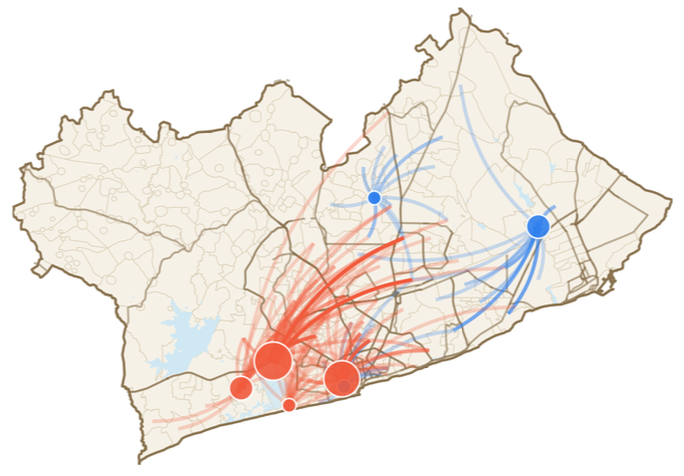
Urbanisation generates powerful agglomeration benefits but also severe congestion externalities that require regulation and public goods provision. In developing megacities, governments lack the fiscal and enforcement capacity to implement textbook solutions. In their absence, unregulated private provision emerges across sectors such as waste, sanitation, water, and transport, leaving externalities largely unaddressed. What can economics offer cities that cannot implement textbook policies? We study whether limited, feasible regulation can leverage informal markets to deliver public services at scale, focusing on trash collection in Accra, Ghana. Using novel data, we document an imperfect but functioning market: households pay informal tricycle collectors for door-to-door collection, yet prices remain too high for universal access, and final disposal occurs largely at illegal dumpsites. Counterfactual results show that a modest subsidy achieves roughly 80% of the efficient outcome, substantially reducing environmental damages while generating larger welfare gains at lower cost than planned infrastructure expansion.
Presentations: (2025) LSE Environment Camp, LSE IO-DEV Workshop, CURE, Guest Lecture at Kyiv School of Economics; (scheduled) STEG Annual Conference 2026
Funders & Partners: International Growth Centre (IGC), STICERD, Innovations for Poverty Action (IPA), DataPlas Ghana
Ray of Hope? China and the Rise of Solar Energy
with Robin Burgess, David Laszlo, Pol Simpson, John Van Reenen, and Yifan Wang
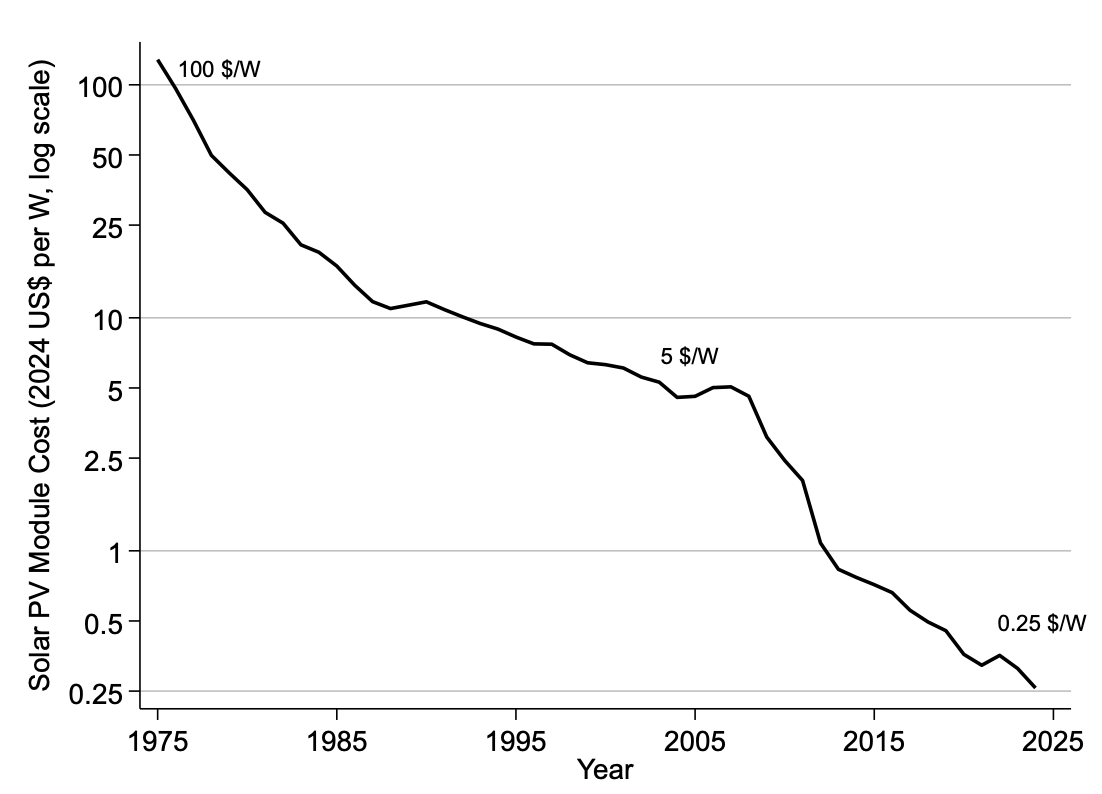
Do industrial policies that promote clean energy offer a "ray of hope" increasing a country's economic growth and welfare whilst simultaneously reducing carbon emissions? We study the impact of Chinese solar subsidies whose implementation by cities coincided with a dramatic fall in global solar prices. We construct new panel data on city-level solar policies, patenting and output. Using synthetic-difference-in-differences between 2004–2020, we find that production and innovation subsidies were more effective than demand-side subsidies in generating large and persistent increases in local innovation, firm numbers, output and exports.
Presentations: (2023) NBER Summer Institute EEE, Stanford SITE; (scheduled) ASSA Annual Meeting in Philadelphia
Channeling Density: Sewerage Investments in 19th-Century Paris
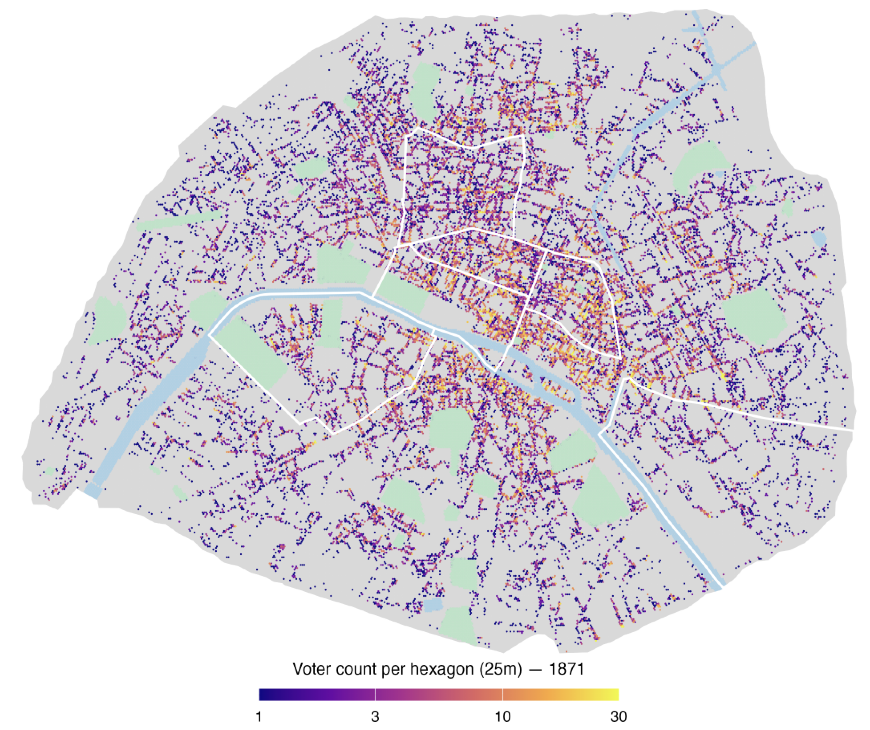
The internal structure of cities is shaped by localised production and residential externalities. Lack of sanitation gives rise to negative externalities in the form of pollution and disease transmission. To investigate this hypothesis, we assemble an address-level data set spanning the entire construction period of the Parisian sewage network during the 19th century.
Work in Progress
The Miracle on the Han: Urbanisation, Industrial Policy, and Rural Development
with Oriana Bandiera, Robin Burgess, Tim Dobermann, Jay Euijung Lee, Jeongkyun Won, and Hyunjoo Yang
Economic growth involves the spatial and sectoral reallocation of people and firms. South Korea rose from poverty to become a leading industrialised economy in a remarkably condensed timeline. We are creating a new historical database tracking all facets of South Korea's structural transformation from the mid- to late-20th century.
Funders & Partners: Structural Transformation and Economic Growth (STEG), Economic and Social Research Council (ESRC)
Electricity Supply and Firm Agglomeration in Ghana
Electricity is a crucial input for modern production, yet its quality across time and space varies substantially. We ask how the endogenous allocation of electricity affects firm productivity and agglomeration, combining administrative data on electricity consumption, engineering records on outages, and a detailed firm panel from a national census.
Funders & Partners: International Growth Centre (IGC)
Water, Sanitation, and Climate Resilience in the Tropics
Using geolocated information on over 400,000 water points and health surveys across Sub-Saharan Africa, we document that access to functioning water and improved sanitation increases villages' resilience to high temperatures, reducing mortality and disease incidence.
Funders & Partners: International Growth Centre (IGC)
Policy Work
Water and Sanitation Provision in Developing Cities
with Mikey Blake, Victoria Delbridge, Ed Glaeser, and Yoshiki Wiskamp